Choosing among video switchers with HDMI can be difficult when you need reliable camera switching, clean streaming output, and controls that fit your production style. The right model depends on input types, resolution, audio needs, portability, and how much automation you want.
We compare 10 options for creators, educators, event teams, and small production crews, highlighting the features that matter most before you buy.
Best 10 Video Switchers with Hdmi Picks for 2026
Best Compact Streaming Pick

- Four HDMI inputs with multiview
- Built-in streaming and recording
- Integrated audio mixer and production effects
Best For: Compact multicamera livestreams and presentations
Best for Larger HDMI Setups

- Eight HDMI inputs for larger productions
- Built-in monitor and AUX output
- 18-channel audio mixer with effects
Best For: Live events and multi-source HDMI production
Best All-in-One Streaming Deck

- Four HDMI inputs and dual HDMI outputs
- Streams to three platforms simultaneously
- Records, plays back, and supports portrait mode
Best For: Feature-rich livestreams, podcasts, and events
Best Built-In Monitor Option

- Integrated 4.5-inch multiview display
- USB 3.0 UVC streaming for OBS
- PTZ control and portrait production modes
Best For: Small studios, churches, and vertical livestreams
Best Compact 4K Pick
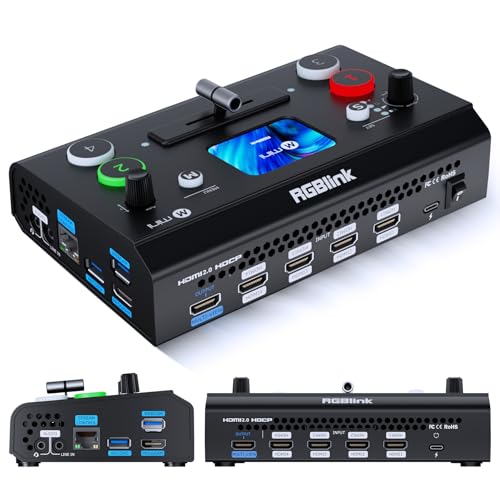
- Four HDMI inputs for multi-camera setups
- Dual 1080p outputs and UVC webcam mode
- Optional TAO Cloud features include recording and PTZ control
Best For: Entry-level multi-camera streaming in a compact footprint
Best Professional Connectivity

- Four HDMI and four SDI inputs
- Supports advanced keys, PIP, and T-bar transitions
- Streams to up to three platforms simultaneously
Best For: Mixed HDMI/SDI live events and advanced streaming workflows
Best Simple HDMI Starter

- Four HDMI inputs with up to 2K support
- USB 3.0 webcam output for streaming software
- Includes transitions, PIP layouts, and LAN control
Best For: Solo streamers building a simple multi-camera setup
Hybrid Production Powerhouse

- 4 HDMI plus 4 SDI inputs
- Records 8 ISO feeds and PGM
- XLR audio and triple RTMP streaming
Best For: Complex multi-camera productions using HDMI and SDI sources
Portable HDMI Control Center
Mixer Plus Compact Video Switcher

- Four HDMI inputs with 4-inch screen
- 30 transitions and four scene presets
- PTZ, keying, PIP, and AUX output tools
Best For: Portable HDMI streaming and small multi-camera productions
Integrated 4K Hybrid Mixer

- Four HDMI and four SDI inputs
- 5.5-inch screen with PTZ control
- Recording and multi-protocol streaming
Best For: Professional hybrid HDMI, SDI, PTZ, and network productions
Best Compact Streaming Pick – ATEM Mini Pro HDMI
The Blackmagic Design ATEM Mini Pro is a practical choice among video switchers with HDMI for creators who need four-camera switching, built-in streaming, recording, and monitoring in a compact unit. It accepts four HDMI sources and includes Ethernet, USB-C, and analog audio connections.
Best For: Multicamera livestreams, online education, business presentations, and esports events.
Pros:
- Four HDMI inputs with a multiview output for monitoring.
- Built-in streaming, recording, and a six-input, two-channel audio mixer.
- Supports DVE, luma, linear, chroma, and pattern transitions and keys.
Cons:
- Provides four HDMI inputs, fewer than the Roland V-8HD.
- Its output and USB-C workflow may require additional equipment for more complex routing.
Choose the ATEM Mini Pro when ease of deployment and integrated streaming matter more than a larger input count. Its compact design and broad transition toolkit make it well suited to small production teams.
Best for Larger HDMI Setups – Roland V-8HD
The Roland V-8HD is one of the more capable video switchers with HDMI for productions that need eight HDMI sources, flexible output routing, and extensive audio control. Its built-in preview monitor and automated switching features help streamline live-event workflows.
Best For: Live events, presentations, broadcasts, and productions with many HDMI cameras or sources.
Pros:
- Mixes up to eight HDMI sources in a compact design.
- Includes a built-in multiview monitor and AUX output capability.
- Offers an 18-channel digital audio mixer, effects, and sync delay.
- Provides keying, still storage, macros, presets, and automated switching.
Cons:
- Heavier and larger than the ATEM Mini Pro and Osee GoStream Deck.
- Its broader feature set may be more than a simple two- or four-camera setup requires.
The V-8HD stands out when input capacity and routing flexibility are priorities. It is a strong fit for users who want advanced switching and audio tools without moving to a larger rack-style system.
Best All-in-One Streaming Deck – GoStream Deck HDMI Pro
The Osee GoStream Deck HDMI Pro combines four HDMI inputs with streaming, recording, playback, audio controls, and portrait or landscape production modes. For shoppers comparing video switchers with HDMI, it offers a broad connection set, including dual HDMI outputs, USB-C, Ethernet, and SD card support.
Best For: Podcasts, conferences, worship services, weddings, online meetings, and multichannel streaming.
Pros:
- Supports simultaneous streaming to three platforms through Ethernet.
- Records to an SD card or USB SSD and supports MP4 playback.
- Includes chroma key, PIP, graphics overlays, and downstream logo or lower-third keying.
- Offers a physical control panel with PVW/PGM buses, T-bar, and macros.
Cons:
- Has four HDMI inputs, so it is less suited to larger source counts than the Roland V-8HD.
- Its many streaming and production functions may require more setup than a basic switcher.
The GoStream Deck is a versatile choice for operators who want switching, streaming, recording, and playback in one device. Its portrait mode and multi-platform streaming support are particularly useful for modern online productions.
Best Built-In Monitor Option – 4-Channel HDMI Switcher
This four-channel HDMI video switcher is designed for operators who want monitoring and production controls integrated into the unit. Its 4.5-inch display shows inputs, Program, Preview, resolution status, and audio levels, while USB 3.0 UVC provides direct computer streaming without a separate capture card.
Best For: OBS streaming, portrait-oriented social content, churches, studios, and small live events.
Pros:
- Built-in 4.5-inch multiview display reduces the need for a separate monitor.
- Supports 30 transition effects, portrait mode, chroma key, luma key, PIP, DSK, and logo overlays.
- Provides VISCA-over-IP PTZ control with four presets per compatible camera.
- Includes USB 3.0 UVC streaming and configurable AUX output options.
Cons:
- Only supports four HDMI sources.
- PTZ control depends on compatible cameras using VISCA over IP.
This model is a sensible pick when an integrated preview screen and direct USB streaming are high priorities. Its portrait mode and PTZ tools also make it more adaptable for vertical content and controlled studio setups.
Best Compact 4K Pick – RGBlink Mini V3
If you want video switchers with hdmi for a compact multi-camera setup, the RGBlink Mini V3 combines four HDMI inputs, a 2.1-inch touch screen, dual 1080p HDMI outputs, and UVC webcam mode. Its feature set is flexible, though some advanced functions require optional TAO Cloud activation.
Best For: Entry-level creators and small live productions needing HDMI switching, preview/program outputs, and webcam connectivity.
Pros:
- Four HDMI inputs support multi-camera productions.
- Dual HDMI outputs can provide program and preview feeds.
- Includes a touch screen, T-bar control, PIP layouts, chroma key, and transition effects.
- Can record to USB drives up to 2TB and operate as a UVC webcam.
Cons:
- Recording and selected advanced features require optional TAO Cloud licensing.
- Activation requires updated firmware, Ethernet internet access, and account binding.
- A 35W or higher USB-C power adapter is recommended for stable performance.
The Mini V3 is a versatile choice when space and HDMI connectivity matter. Confirm the licensing requirements and camera compatibility before buying, especially if recording or PTZ control is essential.
Best Professional Connectivity – Osee GoStream Duet
Osee GoStream Duet Multiple Camera SDI and HDMI Live Stream Video Mixer Switcher
Check Price On AmazonAmong video switchers with hdmi, the Osee GoStream Duet stands out for combining HDMI and SDI connectivity with broad source selection. It supports computer-based control, multiple keying effects, portrait or landscape production, and streaming to up to three platforms at once.
Best For: More demanding live events that use mixed HDMI and SDI cameras and need flexible streaming or control options.
Pros:
- Accepts four SDI, four HDMI, USB-C, NDI HX, and playback sources.
- Offers MIX, DIP, WIPE, and T-bar transitions.
- Includes PIP, chroma key, luma key, pattern key, DSK, and multisource effects.
- Can stream to up to three platforms through Ethernet, a phone hotspot, OBS, or vMix.
Cons:
- Its larger feature set may be more than needed for a simple HDMI-only setup.
- NDI HX requires downloading the latest firmware to unlock the included license.
- Setup and control options may require more learning than a basic switcher.
The GoStream Duet is the strongest fit here for mixed-format productions and advanced live workflows. Choose it when SDI support, multiple control methods, or simultaneous platform streaming justify the added complexity.
Best Simple HDMI Starter – RGBlink Mini
For creators comparing video switchers with hdmi, the RGBlink Mini offers a straightforward four-input design for live streaming. It accepts up to 2K HDMI signals, provides USB 3.0 webcam output, and includes useful transitions, picture-in-picture layouts, and remote control over LAN.
Best For: Solo streamers who want simple four-camera HDMI switching for platforms such as YouTube, Facebook, Instagram, or TikTok.
Pros:
- Four HDMI inputs support multi-camera streaming.
- USB 3.0 output is recognized as a webcam by computers and streaming software.
- Includes 14 transition effects and nine picture-in-picture layouts.
- Supports six-picture preview or program display and LAN remote control.
Cons:
- It supports up to 2K input and output rather than 4K.
- Onboard recording is not available; the notes direct buyers to Mini-Pro or higher models.
- Its listed power source is battery powered, so power planning may matter for longer sessions.
The RGBlink Mini is a practical starting point for HDMI-based streaming when recording and 4K production are not priorities. Its webcam-style USB output keeps the connection to OBS and similar software uncomplicated.
Hybrid Production Powerhouse – Osee GoStream Duet 8 ISO
If you need video switchers with HDMI that can also accommodate professional SDI cameras, the Osee GoStream Duet 8 ISO is built for complex live productions. Its four HDMI 2.0 inputs accept signals up to 4K60, while four 3G-SDI inputs support longer cable runs and mixed camera setups.
Best For: Churches, event crews, podcasts, and multi-camera productions that need extensive recording, audio, and streaming capabilities.
Pros:
- Combines four HDMI and four SDI inputs in one switcher.
- Records eight ISO feeds plus the program output, with H.264 or H.265 encoding.
- Includes professional XLR audio connections, phantom power, and audio processing tools.
- Supports NDI|HX, SRT, RTMP, USB UVC output, and streaming to up to three RTMP destinations.
Cons:
- Its broad feature set may be more than a simple HDMI-only setup requires.
- Outputs are limited to 1080p even though HDMI inputs support up to 4K60.
The GoStream Duet 8 ISO stands out when production flexibility and recovery options matter. Eight-channel ISO recording, built-in audio processing, layered graphics, and multi-destination streaming make it a strong choice for demanding workflows rather than basic camera switching.
Portable HDMI Control Center – Mixer Plus Compact Video Switcher
For shoppers seeking video switchers with HDMI in a compact format, the Mixer Plus combines four HDMI inputs with a built-in 4-inch screen. It provides real-time multi-view monitoring, making it practical for mobile streaming, online classes, events, and small multi-camera productions.
Best For: Portable HDMI setups for YouTube, OBS, Zoom, online teaching, and small live events.
Pros:
- Four HDMI inputs and a built-in 4-inch multi-view display.
- Offers zero-latency switching, 30 transition effects, and four scene presets.
- Includes chroma key, luma key, PIP, DSK, logo overlay, and PTZ control via VISCA over IP.
- Customizable AUX HDMI output can route inputs, program, preview, patterns, or multi-view.
Cons:
- It is HDMI-only, so it does not directly support SDI sources.
- The listed audio output mode is headphone rather than XLR.
The built-in monitor is the main convenience advantage: you can check all four sources, program, preview, resolution indicators, and audio meters without depending entirely on an external display. It is a sensible fit when portability and HDMI workflow simplicity matter most.
Integrated 4K Hybrid Mixer – Tenveo PC500 Video Switcher
The Tenveo PC500 is a versatile option among video switchers with HDMI, pairing four HDMI inputs with four SDI inputs and a 5.5-inch full-HD screen. Two HDMI inputs support 4K60 input, while the switcher provides 1080p60 output for live streaming and production.
Best For: Professional events, churches, studios, conferences, classrooms, and productions using HDMI, SDI, PTZ, and network sources.
Pros:
- Supports four HDMI and four SDI inputs, plus USB and NDI|HX3 sources.
- Includes a 5.5-inch monitoring screen and customizable HDMI and SDI outputs.
- Supports PTZ control, including presets, cruise tracks, and camera parameter adjustments.
- Offers USB and SD-card recording, UVC output, and SRT, RTMP, RTSP, and NDI|HX3 streaming.
Cons:
- Live output is limited to 1080p60 despite support for 4K60 input.
- Its professional controls and hybrid connectivity may be excessive for basic HDMI switching.
- The supplied notes specify two simultaneous streaming platforms, fewer than some larger streaming systems.
With hybrid inputs, PTZ management, network video support, recording, and an integrated display, the PC500 is designed as a central production hub. It is particularly compelling when a workflow needs both traditional camera connections and network-based sources.
How We Picked These Video Switchers with Hdmi
We selected models across several use cases and budgets, from compact HDMI switchers for home studios to larger hybrid units with SDI, XLR audio, multiview displays, recording, and streaming features. Our comparison focuses on practical production capabilities: the number and type of inputs, supported resolutions and frame rates, switching workflow, monitoring, audio connectivity, portability, and streaming or recording options.
Because specifications can vary by firmware and configuration, verify the manufacturer’s current limits before purchase—especially when mixing 4K cameras, 1080p displays, USB output, and SDI sources.
Quick Comparison
- Best for straightforward streaming: Compact HDMI models with built-in USB streaming are easy to deploy for classes, interviews, and small live shows.
- Best for broader production control: Larger switchers add multiview, transitions, keying, macros, audio mixing, and more physical controls.
- Best for hybrid camera systems: Models combining HDMI and SDI inputs suit crews using both consumer and professional cameras.
- Best for portable setups: Small units with integrated screens reduce the need for an external monitor in mobile productions.
Key Buying Factors for Video Switchers with Hdmi
Inputs, Outputs, and Signal Compatibility
Count the cameras and other sources you plan to connect, then leave room for expansion. HDMI inputs are convenient for mirrorless cameras, camcorders, laptops, and media players. If your cameras use SDI, choose a hybrid switcher or budget for converters. Also check whether the unit provides HDMI program output, multiview output, USB video, or network streaming.
Resolution and Frame-Rate Support
Do not assume that a switcher advertised as 4K records, streams, and switches in 4K. Some accept 4K signals but output or stream at 1080p. Confirm supported formats, frame rates, scaling behavior, and whether all inputs must match.
Audio and Monitoring
For cameras with inconsistent audio, look for embedded-audio control, microphone inputs, XLR connectivity, headphone monitoring, delay, and independent level adjustment. A multiview display is valuable for checking focus, framing, audio meters, and active program output before a mistake reaches the audience.
Workflow and Reliability
Physical buttons are often faster during live production, while touchscreen or software control can provide deeper configuration. Look for preview/program switching, transitions, picture-in-picture, chroma keying, stills, macros, and saved scenes if your shows require repeatable setups. Stable power, cooling, firmware support, and a clear return policy also matter for live events.
Who Should Buy Which Video Switchers with Hdmi?
New streamers and educators should prioritize simple HDMI connectivity, USB streaming, and an intuitive layout. Creators producing interviews or multi-camera shows may benefit from multiview, audio mixing, transitions, and recording. Event teams and small production crews should consider more inputs, physical controls, redundant workflow options, and hybrid HDMI/SDI support. Mobile operators will appreciate an integrated screen and compact design, but should verify battery or power requirements. Finally, 4K-focused buyers should check the complete signal path—including cameras, cables, displays, capture devices, and streaming platform limits—rather than relying on the switcher’s headline resolution alone.