The right standalone DMX controller can make a lighting rig easier to program, faster to operate, and more reliable during a live performance. The models in this roundup cover compact scene controllers, traditional console-style units, and software-assisted options.
Whether you need simple dimming for a few fixtures or chase programs for a mobile DJ setup, compare channel capacity, programming workflow, connectivity, and portability before buying.
Best 10 Standalone Dmx Controllers Picks for 2026
Best for Multi-Universe Control

- Four-universe support
- 37 backlit silicone buttons
- Four rotary encoders and four outputs
Best For: DJs and operators managing multi-universe lighting rigs
Best Traditional Console
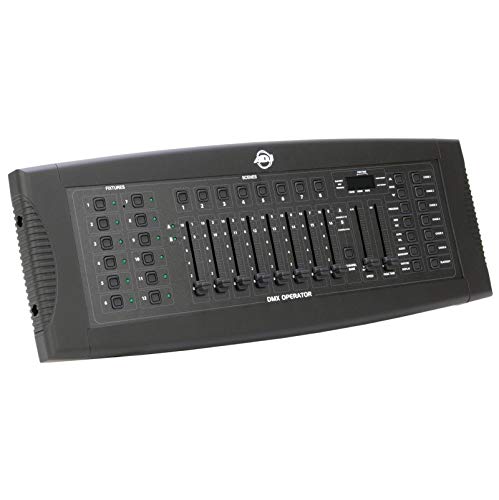
- 192-channel DMX control
- Up to 12 fixtures
- Six programmable chase programs
Best For: DJs and event operators using physical faders
Best for DJ Software Integration

- Two DMX universe I/O
- Dual USB for DJ transitions
- Touch strip, encoders, and RGB pads
Best For: DJs using SoundSwitch and compatible DJ hardware
Best Simple Cue Playback

- Five physical cue buttons
- Up to 10 button actions
- DMX512, Art-Net, and sACN recording
Best For: Fixed installations and venues needing repeatable cue recall
Best Touchscreen Control

- 4.3-inch color touchscreen
- Supports up to four universes
- 37 backlit buttons with 5-pin DMX I/O
Best For: Advanced lighting setups needing multi-universe control
Best Chase Programming

- Controls up to eight intelligent lights
- 96 DMX channels
- Six chases with up to 999 steps each
Best For: DJs and small stages using repeatable lighting chases
Best Scene Capacity

- 384 DMX channels
- 30 banks with eight scenes each
- Supports up to 24 fixtures
Best For: Live and stage setups requiring extensive scene programming
Portable Simplicity
ADJ SDC12 12-Channel DMX Controller

- 12 channel faders and a master fader
- Battery or 12V DC operation
- 3-pin and 5-pin DMX outputs
Best For: Simple demos and portable lighting control
Compact Standalone Programming

- 32-channel PC and standalone output
- Internal memory for stored DMX steps
- USB-C, DMX Record, and DMX Trigger modes
Best For: Compact computer-assisted and standalone setups
Scene-Building Control
192-Channel DMX512 Lighting Console

- Controls up to 12 fixtures
- Stores up to 240 scenes
- Voice control and adjustable transitions
Best For: Programmed DJ, event, club, and church lighting shows
Best for Multi-Universe Control – WMX1 Mk2
The ADJ WMX1 Mk2 is a strong choice among standalone DMX controllers when you need hands-on access to multiple universes and physical controls. Its 37 backlit silicone buttons and four rotary encoders provide a practical layout for programming and operating lighting setups.
Best For: DJs, small production teams, and operators managing multi-universe lighting rigs.
Pros:
- Supports up to four DMX universes.
- Includes four output sockets.
- Backlit buttons support operation in darker environments.
- Compact 10 x 9.25 x 3.5-inch design weighs 2.36 pounds.
Cons:
- Its advanced multi-universe feature set may be more than basic users need.
- The supplied notes do not specify the included lighting-control software or fixture capacity.
Choose the WMX1 Mk2 if direct tactile control and expansion across several universes matter more than a minimal, entry-level interface.
Best Traditional Console – DMX Operator 192
ADJ Products, DMX Operator, 192-Channel DJ DMX 512 with 6 Chase Programs and 8 Fade Switches
Check Price On AmazonThe ADJ DMX Operator 192 offers a straightforward console-style approach to standalone DMX controllers. It operates up to 192 DMX channels, supports up to 12 fixtures, and provides programmable scenes and chases for live playback.
Best For: DJs and event operators controlling conventional or moving lights with physical faders and chase controls.
Pros:
- Controls up to 12 fixtures with up to 16 DMX channels each.
- Records up to six programmable chase sequences.
- Includes fade and step-speed controls for chase playback.
- Uses a rack-friendly 19-inch, 3U form factor.
Cons:
- It is limited to six recorded chase programs.
- The unit is relatively large and heavy compared with compact controllers.
- Power operation is specified as 120V or 220V, not multi-voltage.
This model suits users who prefer dedicated physical controls and conventional DMX fixture management over a software-focused workflow.
Best for DJ Software Integration – SoundSwitch Control One
The SoundSwitch Control One combines standalone-style hardware control with direct SoundSwitch software operation. It offers two DMX universe inputs and outputs, dual USB connections, tactile pads, encoders, and compatibility with selected Engine DJ and AlphaTheta workflows.
Best For: DJs who want tactile lighting control alongside SoundSwitch, Engine DJ, rekordbox, or compatible AlphaTheta equipment.
Pros:
- Provides two DMX universes with input, output, and thru options.
- Dual USB supports smoother DJ transitions.
- Includes a touch strip, encoders, and customizable RGB performance pads.
- Supports live audio BPM detection from external audio sources.
Cons:
- Its primary control relationship is with SoundSwitch software.
- Some rekordbox and PRO DJ LINK Bridge workflows require a laptop.
- The supplied notes do not describe it as a fully independent console for all setups.
Control One is best viewed as a tactile performance interface for a software-centered lighting system, especially for DJs already using compatible DJ hardware.
Best Simple Cue Playback – Pknight Scene Recorder
The Pknight 5-Button DMX Scene Recorder is designed for repeatable cue playback rather than complex live programming. It can record DMX512, Art-Net, and sACN signals, then let venue staff recall scenes from five physical buttons without keeping the original console or computer connected.
Best For: Fixed installations, venues, DJs, churches, and small events that need simple, repeatable cue triggering.
Pros:
- Five buttons provide direct tactile cue control.
- Each button can trigger one scene on press and another on release, allowing up to 10 actions.
- Records DMX512, Art-Net, and sACN signals.
- Supports standalone playback after scenes are recorded.
Cons:
- Five-button operation is less suited to complex live programming.
- Its 20.1-inch package length may be less convenient for highly portable setups.
- The supplied notes do not specify the number of scenes that can be stored beyond the 10 button actions.
For installations where nontechnical staff need reliable cue recall, this controller offers a simpler daily interface than a full lighting console.
Best Touchscreen Control – ADJ WMX1 Mk3
The ADJ WMX1 Mk3 is a feature-rich option among standalone DMX controllers, combining a 4.3-inch color touchscreen with physical backlit controls. Its 5-pin DMX input and output, WLINK compatibility, and support for up to four universes make it suited to more advanced lighting setups.
Best For: Users who want touchscreen operation and multi-universe control in a compact console.
Pros:
- 4.3-inch color touchscreen provides an accessible control interface.
- Supports up to four universes.
- Includes 37 backlit buttons and 5-pin DMX In/Out.
- Compact design weighs 7.5 ounces.
Cons:
- Its broader feature set may be more than needed for simple lighting rigs.
- Uses 5-pin DMX connections, which may not match every existing setup.
The WMX1 Mk3 stands out when you need expanded standalone control without moving to a larger console. Its touchscreen and multi-universe support make it a flexible choice for complex lighting arrangements.
Best Chase Programming – CHAUVET DJ Obey 10
The CHAUVET DJ Obey 10 is a straightforward choice among standalone DMX controllers for programming multiple intelligent lights and repeatable chase sequences. It controls up to eight lights, offers 96 DMX channels, and provides six chase sets with up to 999 steps each.
Best For: DJs and smaller stage setups that need programmable chases for up to eight intelligent lights.
Pros:
- Controls up to eight intelligent lights.
- Provides 96 DMX channels of control.
- Stores six sets of chases with up to 999 steps each.
- Supports sequential linking of chases.
Cons:
- Its control capacity is limited to 96 DMX channels.
- The 22.2-inch-wide chassis may require more storage space than compact controllers.
The Obey 10 is a practical pick when chase sequencing matters more than advanced multi-universe features. Its defined capacity and extensive step storage suit repeatable DJ and small-stage shows.
Best Scene Capacity – 384CH DMX512 Controller
This 384-channel DMX512 controller is built for program editing in bar, club, live, and stage-lighting applications. It provides 30 banks with eight programmable scenes each, supports up to 24 fixtures, and includes an LED gooseneck light for console operation.
Best For: Stage and live-lighting users who need extensive scene storage and 384-channel control.
Pros:
- Offers 384 DMX channels.
- Provides 30 banks of eight programmable scenes.
- Supports up to 24 fixtures.
- Compact structure includes side handles and an LED gooseneck light.
Cons:
- At 6 pounds, it is heavier than the most compact controller options.
- The supplied dimensions indicate a relatively long 24-inch console.
With substantial channel capacity and scene storage, this controller is aimed at users managing more involved lighting programs. Its practical hardware features also support operation during live shows.
Portable Simplicity – ADJ SDC12 12-Channel DMX Controller
ADJ Products SDC12, 12 Channel Basic DMX Controller, Easily Fade and Dim Multiple Lights
Check Price On AmazonThe ADJ SDC12 is a straightforward choice among standalone dmx controllers for basic setups, demos, and users who want hands-on control without a complicated programming workflow. Its 12 channel faders and master fader make fading and dimming multiple lights easy.
Best For: Portable demos, simple lighting systems, and permanent setups requiring basic 12-channel control.
Pros:
- 12 channel faders plus a master fader provide direct, easy-to-manipulate control.
- Compact, lightweight design can operate from a 9V battery or 12V DC power supply.
- Supports standard 3-pin and 5-pin DMX connections for daisy-chaining fixtures.
Cons:
- Limited to 12 channels, making it less suitable for complex lighting rigs.
- The 9V battery is not included.
The SDC12 favors portability and simplicity over advanced programming. It is a practical fit when you need reliable manual control and do not require extensive scene storage or intelligent-light management.
Compact Standalone Programming – Club 32 USB DMX Controller
The Club 32 is one of the more compact standalone dmx controllers for users who want computer-assisted programming plus onboard playback. It provides 32 output channels, USB-C connectivity, internal memory, and included software in a small aluminum housing.
Best For: Compact installations and users who want to create or record DMX control through a computer before running shows standalone.
Pros:
- Provides 32 DMX output channels in both PC and standalone modes.
- Internal 200 KB memory supports approximately 200 to 2,000 DMX steps.
- Supports DMX In/Out, DMX Record, and DMX Trigger modes.
- Small, lightweight aluminum housing is easy to place or transport.
Cons:
- Its USB-C input requires a computer or compatible setup for PC-based control.
- The compact 32-channel format may not suit larger, highly complex systems.
This controller is a useful middle ground between a basic manual console and a larger lighting desk. Its value comes from combining software-based setup with stored standalone playback in a one-pound enclosure.
Scene-Building Control – 192-Channel DMX512 Lighting Console
This 192-channel console is designed for standalone dmx controllers shoppers who need more fixture capacity and programmable scenes. It can control up to 12 intelligent lights with up to 16 channels each, while offering up to 240 scenes and voice control.
Best For: DJs, clubs, weddings, churches, and other shows that need multiple fixtures, programmable scenes, and timed lighting transitions.
Pros:
- 192 channels can control up to 12 fixtures with up to 16 channels each.
- Supports up to 240 scenes and up to 40 steps per scene.
- Adjustable pause and fade times enable customized transitions.
- Voice control and a clearly organized seven-section layout support accessible operation.
Cons:
- The larger feature set may be more than needed for simple lighting tasks.
- Uses a corded electric power source rather than battery operation.
- Its DMX output is specified as a 3-core XLR connection.
With extensive scene capacity and timing adjustments, this console is better suited to programmed shows than quick, one-fader control. The voice-control feature adds flexibility, while the 3-pin DMX output supports common professional lighting connections.
How We Picked the Best Standalone Dmx Controllers
We selected these controllers to represent the main ways performers and lighting operators manage DMX fixtures without relying on a full computer-based production system. Our comparison considers channel count, scene and chase programming, fixture compatibility, hands-on controls, portability, software requirements, and likely use cases.
Because lighting needs vary widely, a compact controller for a small uplighting rig is not directly comparable to a larger console for multiple moving lights. We therefore focused on practical value within each category rather than treating channel count as the only measure of quality.
Quick Comparison
- Simple dimming: Basic 12-channel controllers suit small rigs with conventional dimmer-style operation.
- Compact live control: Button-based scene and cue controllers are useful for quick changes during performances.
- DJ and mobile setups: Mid-range consoles with banks, scenes, and chases offer more programming flexibility without excessive bulk.
- Larger fixture counts: Higher-channel controllers provide more room for multiple fixtures and complex looks.
- Software-assisted control: USB or integrated software options can simplify editing and expand programming capabilities.
Key Buying Factors for Standalone Dmx Controllers
Channel and Fixture Capacity
Check both the stated DMX channel count and the number of fixtures the controller can address. A fixture may use several channels, so a 192-channel unit does not necessarily control 192 individual lights. Leave capacity for future additions rather than buying at the absolute limit.
Scenes, Banks, and Chases
Scenes store lighting states, while banks and chases organize or play them in sequence. If you need timed transitions, repeating patterns, or multiple looks during a show, prioritize a controller with enough memory and clearly labeled playback controls.
Programming Workflow
Faders are useful for direct manual control, while buttons and encoders can make scene selection faster. Software can help with detailed fixture programming, but it may add setup requirements. Choose the workflow you are most likely to use under show conditions.
DMX Connectivity and Build
Confirm the connector type, DMX512 compatibility, and whether the unit supports the cables and fixtures already in your rig. For frequent transport, consider chassis durability, control layout, power requirements, and how easily the controller fits in a case.
Who Should Buy Which Standalone Dmx Controllers?
Beginners and small lighting rigs should look for straightforward channel controllers with uncomplicated dimming and scene recall. Mobile DJs and bands typically benefit from programmable banks, chases, and accessible playback controls. Venues and production users may prefer higher channel capacity and deeper fixture control for more elaborate shows.
If you want computer-based editing or a more visual programming process, choose a USB or software-compatible system. For dependable operation without a laptop at the venue, prioritize a true standalone design with onboard memory, clear controls, and enough capacity for your current fixtures plus reasonable expansion.