The best loop stations for home studios make it easier to layer guitar, vocals, keyboards, percussion, and samples without needing a full production team. The right model can turn a simple idea into a structured arrangement, practice tool, or finished performance.
Our selection covers compact pedals for beginners, versatile multi-track units, and powerful tabletop workstations for creators who need deeper control. Use the guide below to match recording time, track layout, connectivity, and workflow to the way you make music.
Best 10 Loop Stations for Home Studios Picks for 2026
Best Compact Pedalboard Looper

- 32-bit processing for detailed loop audio
- 13 hours of stereo recording and 99 memories
- Rhythms, MIDI, USB, and multicolor display
Best For: Compact home-studio and pedalboard setups
Best Long-Loop Foot-Controlled Option
Zoom MS-90LP+ MultiStomp Looper

- Up to 90 minutes per loop
- Stores 100 loops with 13 hours total capacity
- Five footswitches, rhythms, effects, MIDI, and USB-C
Best For: Long-form looping and hands-free performance
Best Advanced Tabletop Looper

- Five simultaneous stereo phrase tracks
- Extensive input and track effects
- XLR mic inputs, phantom power, and flexible routing
Best For: Complex vocal, electronic, and multi-instrumental setups
Best Sampling-Centered Studio Alternative
Blackbox Studio Compact Sampling Studio

- Standalone sampler and sequencer
- Two audio inputs and headphone output
- Clock I/O, MIDI I/O, and USB connectivity
Best For: Sample-based home studios and MIDI setups
Best Dual-Track Pick

- Two tracks with 13 hours of stereo recording
- Onboard rhythms and color LCD
- XLR, 1/4-inch, and USB connectivity
Best For: Pedal-based home studio looping and songwriting
Best for Deep Layering
Aeros Loop Studio Gold Edition
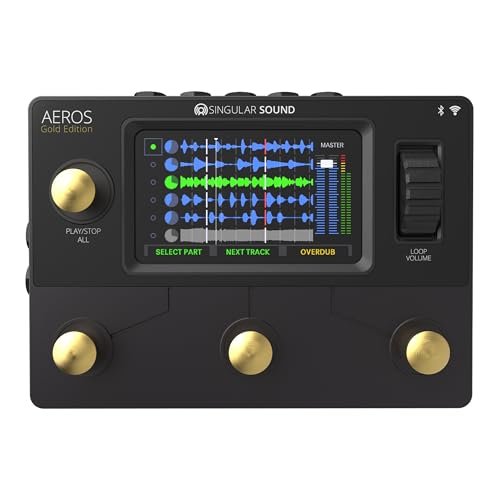
- Six song parts and six stereo tracks
- Up to 10 hours per song
- Touchscreen mixing with MIDI and wireless connectivity
Best For: Complex layered arrangements and multi-instrumental production
Best Tabletop Workflow

- Two simultaneous stereo phrase tracks
- Eight input and track effects available
- 64 phrase memories with MIDI support
Best For: Hands-on desktop looping and effect-heavy performance
Best Tabletop Pick
- Five stereo tracks for layered performances
- Two XLR mic inputs with phantom power
- Tabletop controls, rhythm generator, and USB
Best For: Vocalists and multi-instrumentalists building layered loops at a desk
Best Feature-Rich Floor Unit
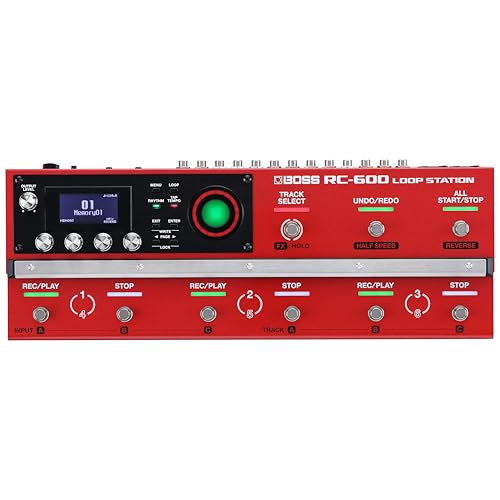
- Six simultaneous stereo phrase tracks
- Large selection of input and track effects
- Nine assignable footswitches with three pedal modes
Best For: Advanced looping musicians who need extensive hands-free control
Best Simple Starter

- Easy record, overdub, playback, undo, and redo controls
- 12 minutes of stereo recording
- Battery powered with optional AC-adaptor support
Best For: Beginners practicing layered loops on guitar, bass, or keyboard
Best Compact Pedalboard Looper – BOSS RC-5 Loop Station
The BOSS RC-5 is a strong choice for musicians building loop stations for home studios who want professional audio processing in a compact pedal format. It combines 13 hours of stereo recording, 99 phrase memories, rhythms, MIDI, USB, and a clear multicolor display.
Best For: Guitarists, instrumentalists, and home-studio users who need a compact looper with extensive storage and connectivity.
Pros:
- 32-bit AD/DA conversion and 32-bit floating-point processing support high-quality recording and playback.
- Offers 13 hours of stereo recording and 99 phrase memories.
- Includes 57 rhythms with A/B variations, seven drum kits, reverse playback, MIDI, and USB.
Cons:
- Single-track looping is less flexible than a multi-track tabletop looper.
- Advanced MIDI and external-control features may require additional setup.
The RC-5 packs substantial looping capacity into a pedalboard-friendly enclosure. Its display, rhythms, and connectivity make it especially practical when space is limited but creative control still matters.
Best Long-Loop Foot-Controlled Option – Zoom MS-90LP+ MultiStomp Looper
The Zoom MS-90LP+ suits loop stations for home studios when long recording times and hands-free control are priorities. It records up to 90 minutes per loop, stores up to 100 loops, and provides dedicated footswitches for common performance functions.
Best For: Guitarists, keyboardists, and performers who want long loops, multiple stored ideas, and direct foot control.
Pros:
- Records up to 90 minutes per loop with 13 hours of total capacity.
- Stores up to 100 loops and includes separate Undo, Stop, Loop FX, and Rhythm switches.
- Provides 68 rhythm patterns, eight loop effects, quantize, stereo I/O, MIDI, and USB-C.
Cons:
- Its dedicated footswitch layout takes more space than a compact single-switch pedal.
- The supplied notes do not specify detailed microphone input or phantom-power features.
With unusually long loop duration and clearly separated foot controls, the MS-90LP+ is built for extended arrangements and performance-oriented workflows. Stereo connectivity also makes it adaptable to guitars, basses, synths, and keyboards.
Best Advanced Tabletop Looper – BOSS RC-505mkII Loop Station
The BOSS RC-505mkII is designed for home studios that need hands-on control over layered arrangements. Its five simultaneous stereo phrase tracks, independent faders, extensive effects, microphone inputs, and flexible routing make it a powerful centerpiece for complex looping.
Best For: Vocalists, electronic musicians, beatmakers, and multi-instrumentalists creating layered tabletop performances.
Pros:
- Provides five simultaneous stereo phrase tracks with dedicated controls and volume faders.
- Includes 49 Input FX types and 53 Track FX types, with dual effects sections.
- Offers two XLR microphone inputs with phantom power, stereo line inputs and outputs, USB, and 99 memories.
Cons:
- Its tabletop design is substantially larger and heavier than a pedal-style looper.
- The broad effects and routing options may be more than a simple looping setup requires.
The RC-505mkII is the most expansive option in this group for arranging multiple independent layers. Choose it when faders, microphone support, effects, and detailed live manipulation matter more than portability.
Best Sampling-Centered Studio Alternative – Blackbox Studio Compact Sampling Studio
The Blackbox Studio is a sampling and sequencing alternative for loop stations for home studios, particularly when the workflow centers on clips, samples, and external MIDI gear. It operates as a standalone unit and includes two audio inputs, headphone output, clock I/O, and MIDI I/O.
Best For: Producers who want a compact standalone sampler/sequencer for sample-based arrangements and MIDI-connected setups.
Pros:
- Combines standalone sampling and sequencing in one device.
- Includes two audio inputs and a headphone output for basic studio monitoring and capture.
- Provides clock I/O, MIDI I/O, USB connectivity, and compatibility with Windows and macOS.
Cons:
- The supplied notes do not specify loop duration, phrase-memory capacity, or dedicated looper controls.
- It has four channels, which may be limiting for larger arrangements.
The Blackbox Studio is better viewed as a sampling-focused companion or alternative than a conventional foot-operated looper. Its standalone design and MIDI and clock connections make it useful for sample-driven home-studio workflows.
Best Dual-Track Pick – BOSS RC-500
For home studios seeking flexible loop stations for home studios, the BOSS RC-500 combines two-track looping, stereo recording, onboard rhythms, and broad connectivity in a compact pedal format. Its 13-hour recording capacity and color LCD make it practical for songwriting, practice, and layered arrangements.
Best For: Musicians who want a pedal-based looper with dual tracks, rhythm accompaniment, and XLR connectivity.
Pros:
- Two-track looping with up to 13 hours of stereo recording
- Onboard rhythm tracks support practice and arrangement building
- Includes XLR and 1/4-inch inputs plus USB import/export
- Color LCD and two-year warranty add usability and reassurance
Cons:
- Requires a 9-volt, 500-milliamp AC adapter
- BMIDI-5-35 adapter cable is available separately
- At 950 g, it is less lightweight than some compact loopers
The RC-500 is a well-rounded choice when dependable dual-track control and long recording time matter more than a tabletop touchscreen interface.
Best for Deep Layering – Aeros Loop Studio Gold Edition
Aeros Loop Studio Gold Edition - 6 Track, Stereo Looper Pedal | Touch Screen and Hands Free Mixing
Check Price On AmazonThe Aeros Loop Studio Gold Edition is built for ambitious home-studio arrangements, offering six song parts, six stereo tracks per song, unlimited overdubs, and substantial storage options. For users comparing loop stations for home studios, its touchscreen mixing and wireless connectivity provide an unusually expansive workflow.
Best For: Guitarists, vocalists, and multi-instrumentalists creating complex layered loops and extended song-based performances.
Pros:
- Supports six song parts and six stereo tracks per song
- Offers unlimited overdubs and up to 10 hours per song
- 32-bit floating-point audio with Reverse, Fade In/Out, and Loop Decay effects
- Touchscreen mixer with MIDI, USB, Wi-Fi, and Bluetooth connectivity
Cons:
- 32GB SD card for expanded storage is not included
- Its larger 8.5-by-6.25-inch footprint may need more desk space
- At 2.3 pounds, it is less portable than smaller pedal-style units
Choose the Aeros when track count, storage, and hands-free mixing flexibility are priorities for a home production setup.
Best Tabletop Workflow – BOSS RC-202
The BOSS RC-202 brings hands-on tabletop control to home studios, with two simultaneous stereo phrase tracks, dedicated loop controls, and extensive effects. It is a strong option among loop stations for home studios when you want to operate the looper while playing guitar, keyboards, or other instruments.
Best For: Desktop performers and producers who value tactile control, layered stereo phrases, and DJ- or sampler-style effects.
Pros:
- Two simultaneous stereo phrase tracks with dedicated controls
- Four input effects and four track effects can be used simultaneously
- Stores 64 phrase memories across eight banks
- Supports optional footswitches, expression pedals, and MIDI
Cons:
- Its tabletop design is larger than a conventional pedal
- External footswitches or an expression pedal are optional
- Uses a 9-volt, 440-milliamp corded power setup
The RC-202 suits creators who prefer visible, fingertip operation and effect-focused looping rather than a traditional foot-operated pedal layout.
Best Tabletop Pick – Boss RC-505 Mk2
For home studios built around hands-on performance, the Boss RC-505 Mk2 is one of the most capable loop stations for home studios. Its tabletop layout provides five stereo tracks, two XLR microphone inputs with phantom power, two stereo line-input pairs, a rhythm generator, and physical button-and-knob controls.
Best For: Singers, beatboxers, and multi-instrumentalists who want a tabletop looper with multiple inputs and five stereo tracks.
Pros:
- Five stereo tracks support layered arrangements.
- Two XLR microphone inputs include phantom power.
- Offers stereo line inputs, rhythm generation, looping controls, and USB connectivity.
- Includes a footswitch, dual footswitch, expression pedal, and AC adaptor.
Cons:
- Its tabletop design is less suited to traditional pedalboard setups.
- The supplied dimensions indicate that it requires dedicated desk or studio space.
The RC-505 Mk2 is a strong choice when your home-studio workflow centers on vocal or instrument layering at a table. It offers broad connectivity and control, though its larger tabletop format may be more equipment than a simple single-loop setup requires.
Best Feature-Rich Floor Unit – BOSS RC-600
The BOSS RC-600 is designed for demanding performers who want advanced control in a home studio or live-oriented rig. It combines six simultaneous stereo phrase tracks with 32-bit AD/DA and floating-point processing, extensive effects, and nine freely assignable footswitches.
Best For: Guitarists, singer-songwriters, and multi-instrumentalists who need deep foot control, multiple stereo tracks, and extensive onboard effects.
Pros:
- Six simultaneous stereo tracks accommodate complex layered performances.
- Includes 49 Input FX and 53 Track FX types, with up to four usable at once in each section.
- Nine freely assignable footswitches and three pedal modes support flexible operation.
- Provides USB connectivity and 32-bit processing for its class-leading sound-quality design.
Cons:
- Its extensive feature set may be more than beginners need.
- At 8.2 pounds, it is less portable than a compact looper pedal.
- The floor-based format is less convenient for tabletop-only workflows.
The RC-600 is the most flexible option here for musicians who expect their looping setup to grow. Its six-track architecture and assignable controls suit intricate performances, while the large effects selection adds considerable creative range.
Best Simple Starter – BOSS RC-1
The BOSS RC-1 keeps looping straightforward, making it a practical entry point for loop stations for home studios. This compact pedal supports recording, playback, overdubbing, undo and redo, with 12 minutes of stereo recording, stereo inputs and outputs, and an intuitive 24-segment loop indicator.
Best For: Guitar, bass, and keyboard players who want an uncomplicated pedal for practicing and building layered phrases.
Pros:
- Simple controls cover recording, playback, overdubbing, undo, and redo.
- Provides 12 minutes of stereo recording time.
- Runs on an included 9-volt alkaline battery or an optional PSA-series AC adaptor.
- Retains the recorded phrase in memory after being turned off.
Cons:
- It offers a simpler feature set than the multi-track RC-505 Mk2 and RC-600.
- The AC adaptor is optional rather than included.
- It has no listed onboard rhythm generator or effects selection.
The RC-1 is a sensible choice for beginners and players who value immediate operation over elaborate routing. Its compact stompbox format and clear loop indicator make it easy to add looping to a home setup without a steep feature-learning curve.
How We Picked the Best Loop Stations for Home Studios
We focused on the features that matter most in a home setup: intuitive recording and overdubbing, audio quality, available loop time, track organization, connectivity, and hands-on control. We also considered whether each unit suits practice, songwriting, live streaming, beat making, or more complex performance arrangements.
Because home studios vary widely, this list includes both straightforward single-track pedals and advanced loop workstations. A compact looper may be the better choice for a guitarist with limited desk space, while a multi-track tabletop unit can serve as the center of a vocal, electronic, or live-looping rig.
Quick Comparison
| Best for | Recommended type | What to prioritize |
|---|---|---|
| Beginners and simple practice | Compact pedal | Easy controls, reliable footswitches, clear overdubbing |
| Songwriting and layered arrangements | Multi-track looper | Independent tracks, memory capacity, rhythm tools |
| Beat making and sampling | Tabletop sampler-looper | Sample triggering, effects, hands-on control |
| Live looping and complex setups | Advanced floor or tabletop workstation | Multiple inputs, routing, synchronization, expression control |
Key Buying Factors for Loop Stations for Home Studios
Track Layout and Workflow
Single-track loopers are usually fastest to learn, but independent tracks give you more control over verses, choruses, and transitions. If you want to mute or replace parts separately, choose a model with dedicated track controls rather than relying on one combined loop.
Recording Time and Memory
Check both the maximum length of an individual loop and the number of memories or songs the unit can store. Short loops are fine for practice, while longer recording times and plentiful phrase memories are useful for complete arrangements and repeatable performances.
Inputs, Outputs, and Synchronization
Think about every source you may connect: instrument, microphone, stereo keyboard, mixer, or audio interface. MIDI, USB, and sync features are valuable if the looper must follow a drum machine, DAW, or other hardware. Stereo I/O is especially important for keyboards and effect-heavy sources.
Audio Quality and Monitoring
Look for high-resolution recording, low-noise inputs, dependable monitoring, and suitable headphone or line outputs. Built-in rhythms and effects can be useful, but they should complement rather than replace a clean signal path.
Control and Physical Size
Footswitch placement matters for hands-free playing, while tabletop controls may be better for beat production and vocal looping. Confirm that the unit fits your desk or pedalboard and supports any external switches or expression pedals you plan to use.
Who Should Buy Which Loop Stations for Home Studios?
Choose a compact pedal if you want a simple, affordable way to practice, sketch song ideas, or layer one instrument. These models are generally the easiest starting point and work well in small rooms.
Choose a midrange multi-track looper if you regularly build full arrangements or need separate control over rhythm, bass, harmony, and lead parts. This category offers a strong balance of flexibility and manageable operation.
Choose a tabletop studio looper if your workflow centers on vocals, samples, beats, or electronic instruments. Hands-on buttons and multiple simultaneous tracks can make performance more fluid than a traditional pedal layout.
Choose an advanced floor-based workstation if you perform complex live sets, use several inputs, or need extensive routing, synchronization, and external-control options. These units cost more and require more setup, but they can become the hub of a serious home studio.