A capture card with passthrough lets you send video to your computer for streaming or recording while continuing to play on a separate display. That makes it easier to build a low-latency setup for consoles, gaming PCs, and cameras.
This roundup compares 10 options across external USB models and an internal PCIe card, with attention to resolution support, refresh rates, connectivity, and the difference between passthrough and actual capture quality.
Best 10 Capture Card with Passthrough Picks for 2026
Premium HDMI 2.1 Capture

- 4K60 capture with HDR10 support on Windows
- 1440p120 and 1080p240 passthrough
- 3.5mm analog audio input
Best For: High-quality console streaming and high-frame-rate gameplay
Versatile Loop-Out Capture

- 4K30 HDMI input and loop-out
- 2K30 or 1080p60 recording
- USB-A and USB-C connectivity
Best For: Cross-platform 1080p or 2K streaming
Internal HDMI 2.1 Powerhouse

- Up to 8K60 passthrough
- 4K60 HDR10 capture
- VRR and 1080p240 support
Best For: High-end Windows and dual-PC streaming
Budget USB Loop-Out Pick

- 4K60 input and loop-out
- 1080p60 or 2K30 capture
- USB-A/USB-C and mic input
Best For: Affordable console and camera streaming
Acer Balanced Capture
4K HDMI Capture Card with Passthrough

- 4K input with 1080p60 output
- HDMI loop-out for low-latency monitoring
- USB-A/USB-C and mic-in connectivity
Best For: 1080p60 console streaming and commentary
XIIXMASK High-Frame-Rate Capture

- 4K60 capture and passthrough
- 1080p recording up to 120FPS
- USB-A/USB-C with audio in and mic out
Best For: High-frame-rate gaming and advanced streaming
VIXLW Simple Loop-Out Capture
1080p USB 3.0 HDMI Capture Card

- 1080p capture with HDMI loop-out
- Plug-and-play USB 3.0 setup
- 3.5mm mic input for commentary
Best For: Simple 1080p console streaming
Best Overall
Newhope 1080p 60FPS Capture Card

- 1080p 60fps capture with low latency
- 4K passthrough via HDMI loop-out
- Mic input and broad OS compatibility
Best For: Smooth gaming capture with commentary
Best Portable Pick
Dcyfol 1080p60 USB Capture Card
- 1080p 60fps capture for streaming
- 4K HDMI loop-out for low-lag play
- Includes USB adapters and extension cables
Best For: Mobile and frequently changing streaming setups
Best Input Flexibility
VIXLW 1080p60 HDMI Capture Card

- Accepts 4K60 and 1080p144 input
- HDMI loop-out for low-delay gameplay
- Mic input and plug-and-play setup
Best For: Windows users with varied HDMI sources
Premium HDMI 2.1 Capture – Elgato 4K S
The Elgato 4K S is a strong choice if you need a capture card with passthrough for current consoles and high-frame-rate gaming. It captures up to 4K60, supports 1440p120 and 1080p240 passthrough, and includes HDR10 support on Windows.
Best For: Console players and creators who want high-quality capture, smooth passthrough, and analog audio input.
Pros:
- Captures video at up to 4K60 with HDR10 support on Windows.
- Supports 1440p120 and 1080p240 passthrough for smooth gameplay.
- Works with PS5, Xbox Series X/S, Switch 2, Windows, macOS, and compatible iPadOS devices.
- Includes a 3.5mm analog audio input for commentary or in-game chat.
Cons:
- Windows HDR10 capture requires Windows 11.
- Requires USB 3.0 Type-C and compatible hardware for full performance.
With near-zero latency, broad platform support, and high-frame-rate passthrough, the 4K S is a well-rounded option for modern console streaming setups. Check your computer and display specifications before buying.
Versatile Loop-Out Capture – UGREEN 4K HDMI Capture Card
The UGREEN 4K HDMI capture card is a practical capture card with passthrough for users who want 4K input and loop-out while recording at up to 2K30 or 1080p60. Its USB-A and USB-C connectivity makes it flexible for laptops, desktops, and compatible tablets.
Best For: Streamers seeking broad operating-system support, 4K loop-out, and straightforward USB connectivity.
Pros:
- Supports 4K30 input and 4K30 HDMI loop-out for real-time monitoring.
- Records up to 2K30 or 1080p60.
- Includes USB 3.0 Type-A and Type-C interfaces.
- Works with Windows, macOS, Linux, Android, and compatible iPads.
Cons:
- 4K recording is not supported; capture is limited to 2K30 or 1080p60.
- PS4 and PS5 require HDCP to be turned off.
- Not compatible with Fire TV Stick, and iPhones cannot be used as UVC data-acquisition devices.
The UGREEN model offers useful passthrough and device flexibility at a lower capture ceiling than 4K-recording options. It is best suited to 1080p or 2K streaming rather than native 4K recording.
Internal HDMI 2.1 Powerhouse – Elgato 4K Pro
The Elgato 4K Pro is an internal capture card with passthrough designed for demanding PC and dual-PC gaming setups. HDMI 2.1 connectivity enables up to 8K60 passthrough, while capture reaches 4K60 and recording supports high frame rates such as 1080p240.
Best For: Windows users building high-end gaming, broadcasting, or dual-PC streaming systems.
Pros:
- Supports up to 8K60 passthrough and 4K60 HDR10 capture.
- Handles up to 1080p240 recording.
- HDMI 2.1 connectivity and VRR passthrough support smooth gameplay.
- Compatible with major streaming and meeting apps, including OBS, Streamlabs, Twitch Studio, Zoom, and Teams.
Cons:
- Requires a Windows 10 system with an available PCIe slot.
- As an internal card, it is less portable than USB capture solutions.
- The supplied specifications list video capture resolution as 1080p, so verify software and system support for higher-resolution workflows.
This is the most capable option in the group for a fixed Windows setup. Its 8K passthrough, VRR support, and dual-PC compatibility make it especially suitable for enthusiasts who prioritize display performance and low latency.
Budget USB Loop-Out Pick – XIIXMASK HDMI Capture Card
This USB capture card with passthrough is a straightforward option for recording and streaming console or camera video. It accepts up to 4K60 HDMI input and loop-out, while sending up to 1080p60 or 2K30 video to the computer through USB 3.0.
Best For: Budget-conscious streamers who want 4K loop-out, USB-A/USB-C compatibility, and a microphone input.
Pros:
- Supports 4K60 HDMI input and loop-out.
- Captures up to 1080p60 or 2K30 through USB 3.0.
- Offers both USB-A and USB-C connectivity.
- Includes a 3.5mm mic input for commentary.
Cons:
- Does not capture 4K; computer output is limited to 1080p60 or 2K30.
- The mic input does not record party chats.
- OBS may need to be restarted after audio setup to restore sound output.
The XIIXMASK card covers the basics well, especially when smooth 4K display loop-out matters more than 4K recording. Its included cable supports USB-A and USB-C connections, making it convenient for varied streaming hardware.
Acer Balanced Capture – 4K HDMI Capture Card with Passthrough
If you need a capture card with passthrough for console streaming, the Acer OCB5B0 combines 4K HDMI input with 1080p at 60Hz output. Its USB 3.0 connection, low-latency performance, and mic input make it practical for gaming, recording, online classes, and live commentary.
Best For: Gamers and creators who want 1080p60 capture, 4K input, simple setup, and direct microphone connectivity.
Pros:
- Supports 4K input and smooth 1080p at 60Hz output.
- Includes HDMI loop-out for low-latency monitoring and gameplay.
- Plug-and-play design works with USB-A or USB-C and does not require external power.
- Compatible with OBS, XSplit, VLC, major platforms, consoles, cameras, Windows, Linux, macOS, and Android devices.
Cons:
- USB 3.0 is required for USB 3.0 operation.
- Its listed capture resolutions top out at 1080p, despite accepting 4K input.
The Acer is a well-rounded choice when dependable 1080p60 capture matters more than native 4K recording. Its included mic-in and dual USB connector options add convenience for flexible streaming setups.
XIIXMASK High-Frame-Rate Capture – 4K60 HDMI Passthrough Card
For demanding game capture, this capture card with passthrough supports 4K60 capture and 4K HDMI passthrough, along with 1080p recording at up to 120FPS. USB-A/USB-C connectivity, broad operating-system support, and dedicated audio ports make it suited to advanced streaming and monitoring setups.
Best For: Streamers and creators who need high-frame-rate 1080p capture, 4K60 support, and flexible device or software compatibility.
Pros:
- Supports 4K60 capture and 4K HDMI passthrough.
- Handles 1080p at up to 120FPS for high-frame-rate gameplay.
- Offers USB-A/USB-C connection options without drivers or external power.
- Includes 3.5mm audio input and microphone output, plus an HDMI cable and USB cable.
Cons:
- Its feature set may be more than needed for basic 1080p streaming.
- Compatibility with iPadOS is specified as iPadOS 17 or later.
The XIIXMASK stands out for its unusually strong frame-rate specifications and 4K60 passthrough. It is the most performance-focused option here for users who want smoother gameplay monitoring and more recording-format flexibility.
VIXLW Simple Loop-Out Capture – 1080p USB 3.0 HDMI Capture Card
This VIXLW model is a straightforward capture card with passthrough for 1080p streaming and recording. It uses USB 3.0, identifies as a webcam without additional drivers, and provides HDMI loop-out so you can monitor gameplay with minimal delay.
Best For: Budget-conscious console players and streamers who want simple 1080p capture with HDMI loop-out and optional mic commentary.
Pros:
- Captures video up to 1080p and supports HDMI loop-out.
- Plug-and-play setup requires no driver or external power supply.
- Works with Windows, Mac OS, Linux, OBS, Twitch, YouTube, Facebook, Twitter, PotPlayer, and VLC.
- Includes a 3.5mm microphone input for external commentary.
Cons:
- Capture resolution is limited to 1080p.
- The microphone input accepts only a 3.5mm TRS standard microphone headset.
- A computer with a USB 3.0 port is required.
The VIXLW keeps the setup uncomplicated and focuses on the essentials: 1080p capture, low-latency loop-out, and broad software support. Choose it when you do not need 4K60 capture or high-frame-rate recording.
Best Overall – Newhope 1080p 60FPS Capture Card
If you want a capture card with passthrough for smooth gameplay and straightforward streaming, the Newhope combines 1080p at 60fps capture with real-time HDMI loop-out. It is plug and play, requires no external power, and works with popular operating systems and streaming software.
Best For: Gamers and creators who want smooth 1080p60 capture, low-latency gameplay, and microphone commentary.
Pros:
- Captures video at 1080p 60fps for smooth recordings and streams.
- 4K passthrough and HDMI loop-out support real-time play on an external display.
- Includes a 3.5mm TRS microphone input for commentary.
- Works with Windows, macOS, Linux, iPadOS 17+, OBS, VLC, and Zoom.
Cons:
- Capture resolution is limited to 1080p, despite 4K passthrough support.
- The microphone input accepts only a 3.5mm TRS standard microphone headset.
The Newhope is a well-rounded option for console and camera setups where smooth 1080p60 capture matters more than recording in 4K. Its included cables, broad compatibility, and two-year manufacturer warranty add practical value.
Best Portable Pick – Dcyfol 1080p60 USB Capture Card
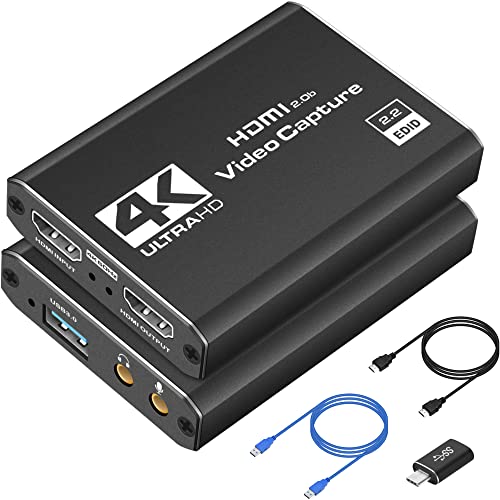
The Dcyfol is a compact capture card with passthrough designed for quick streaming from consoles, cameras, and PCs. It captures at 1080p 60fps, supports 4K HDMI real-time preview, and includes adapters and extension cables for flexible USB connections.
Best For: Creators who move between gaming setups, events, LAN parties, or travel streaming sessions.
Pros:
- Supports 1080p 60fps capture for detailed, smooth streams and recordings.
- 4K HDMI loop-out enables low-lag gameplay while video is captured.
- Plug-and-play operation works with OBS Studio, Streamlabs, and XSplit.
- Includes HDMI and USB extension cables plus a USB-to-Type-C adapter.
Cons:
- Requires a USB 3.0 port and is listed as compatible with Windows and macOS.
- Its capture output is 1080p 60fps rather than 4K recording.
This model stands out for portability and setup flexibility. It is a sensible choice when you need a lightweight capture device with passthrough and bundled connection accessories, provided your computer has USB 3.0.
Best Input Flexibility – VIXLW 1080p60 HDMI Capture Card
The VIXLW offers a versatile capture card with passthrough for HDMI gaming, camera, and set-top-box sources. It accepts 4K input up to 60Hz and 1080p input up to 144Hz, while its USB 3.0 connection captures video for streaming through OBS, Twitch, YouTube, and other supported software.
Best For: Windows users who need broad HDMI source compatibility, microphone input, and high-refresh input support.
Pros:
- Accepts 4K30/60Hz and 1080p120/144Hz video input.
- HDMI loop-out is designed for delayed-free gameplay.
- Plug-and-play operation needs no driver or external power supply.
- Supports microphone commentary through a 3.5mm TRS input.
Cons:
- Output supports up to 2K at 30Hz, while capture is intended for up to 1080p.
- It does not support 4K120Hz or 4K144Hz input.
- The listed warranty is 60 days.
The VIXLW is appealing when input flexibility and passthrough are priorities. Its limitations are important for high-refresh or 4K workflows, but it provides a broad set of connections and useful commentary support for compatible Windows setups.
How We Picked the Best Capture Card with Passthrough
We focused on the features that matter most in a reliable capture setup: HDMI input and output, passthrough resolution, capture resolution, refresh-rate support, USB or PCIe connectivity, compatibility with common streaming software, and setup complexity. We also separated headline specifications carefully. A device may support 4K passthrough while capturing at 1080p, so those capabilities should not be treated as interchangeable.
External USB models are generally easier to move between computers and consoles, while the internal Elgato 4K Pro is better suited to a permanent desktop streaming or recording system. Product descriptions and model names can vary, so verify the exact supported resolution, refresh rate, HDR behavior, and operating-system requirements before buying.
Quick Comparison
| Type | Best For | What to Check |
|---|---|---|
| External USB 3.0 | Console streaming, laptops, flexible setups | USB 3.0 requirement, capture limit, included cables |
| 4K passthrough models | Playing at higher resolution while streaming | Whether 4K is passthrough-only or also captured |
| 1080p60 capture models | Streaming, tutorials, and dependable Full HD recording | Supported input refresh rate and audio handling |
| Internal PCIe | Dedicated desktop production systems | Available PCIe slot, cooling, and software support |
Key Buying Factors for a Capture Card with Passthrough
Passthrough and Capture Resolution
Passthrough is the signal sent to your gaming monitor or television; capture is the signal recorded or streamed by the computer. If you play at 4K but stream at 1080p, look for 4K passthrough plus dependable 1080p60 capture. For 4K recording, confirm that the card explicitly supports 4K capture at the refresh rate you need.
Refresh Rate and Latency
Competitive players should check whether the passthrough path supports 60Hz, 120Hz, or higher at their target resolution. Passthrough should add little noticeable delay, but your display, HDMI cable, console settings, and software can still affect the overall experience.
Connection and Compatibility
USB 3.0 is common among external cards, but the computer must provide a suitable high-speed port and enough bandwidth. Confirm compatibility with Windows or macOS, OBS or other preferred software, and the console or camera you plan to use. HDCP-protected content generally cannot be captured.
Audio and HDR Features
Check whether game audio, microphone mixing, party chat, HDR, and surround formats work as expected. Some cards pass HDR to the display but capture standard dynamic range, while others may require specific software or settings.
Who Should Buy Which Capture Card with Passthrough?
Choose an external USB model if you need portability, a straightforward console setup, or compatibility with a laptop. These are the most practical choices for most streamers.
Choose a 4K-passthrough model if you want to play at 4K without forcing the streamed video to use the same resolution. Confirm the advertised capture limit before purchase.
Choose an internal PCIe card if you stream or record regularly from a powerful desktop and want a cleaner permanent installation with higher-end workflow options.
Choose a basic 1080p60 card for budget-friendly streaming, tutorials, and older consoles where Full HD capture is sufficient. Before ordering, match the card’s ports and specifications to your exact console, display, computer, and desired refresh rate.