The best 4K wireless video receivers make it easier to monitor, stream, present, or distribute high-resolution video without running long HDMI or SDI cables. The right system depends on more than advertised range: resolution, latency, wireless band, connectivity, and receiver capacity all affect real-world performance.
We compare 10 options ranging from simple plug-and-play HDMI kits to professional systems with SDI, HDR, camera control, multi-receiver support, and mobile monitoring. Use the guide below to narrow the choices by workflow, budget, and signal requirements.
Best 10 4K Wireless Video Receivers Picks for 2026
Best Multi-User Monitoring Pick

- 4K30 HDMI transmission with 60ms latency
- Up to four receivers plus Hollyview app monitoring
- Dual-band Smart Channel Scan and UVC streaming
Best For: Film crews and live-production teams needing shared monitoring
Best Plug-and-Play Home Setup

- Pre-paired dual-band plug-and-play connection
- 4K30 input with 1080p60 output
- 3.5mm audio and flexible battery or USB-C power
Best For: Home theaters, presentations, and portable HDMI use
Best HDMI and SDI Flexibility

- 4K30 HDMI transmission with HDMI and SDI I/O
- Supports 23.98, 29.97, and 59.94 FPS SDI output
- LCD, joystick controls, app monitoring, and battery options
Best For: Production crews using mixed HDMI and SDI equipment
Best for Simple 1080p Display Links

- 4K decode with 1080p60 output
- Up to 360 feet open-space range
- Plug-and-play mirror, extend, and multi-transmitter support
Best For: Presentations, classrooms, offices, and home theaters
Professional Production Pick

- 4K30 HDMI with 1080p 3G-SDI support
- Up to 1312-foot line-of-sight range
- Monitoring for up to five destinations
Best For: Film crews and multi-device production monitoring
Streaming-Friendly Value

- 4K30 transmission with about 0.1-second latency
- UVC output for OBS and computer streaming
- 20 selectable 5 GHz channels and loop-out
Best For: Live streaming and flexible multi-camera monitoring
Zero-Delay Performance Pick

- 4Kp30 10-bit HDR over HDMI
- Less than 0.01-second stated latency
- 6 GHz transmission with auto channel selection
Best For: Responsive camera monitoring and A/V production
Best with Extra Features

- 4K60 HDMI plus 3G-SDI/HDMI 1080p support
- Tri-band wireless transmission with multi-device monitoring
- Professional app tools for live production workflows
Best For: Filmmakers, event crews, and live-production teams
Long-Range Home Theater Pick
Vrriis WL095P 4K Wireless HDMI Kit

- Plug-and-play transmitter and receiver pairing
- 4K30 video with synchronized audio
- Dual HDMI outputs and up to 1,150-foot open-field range
Best For: Home theaters, offices, and long-distance HDMI links
Multi-Source Meeting Pick
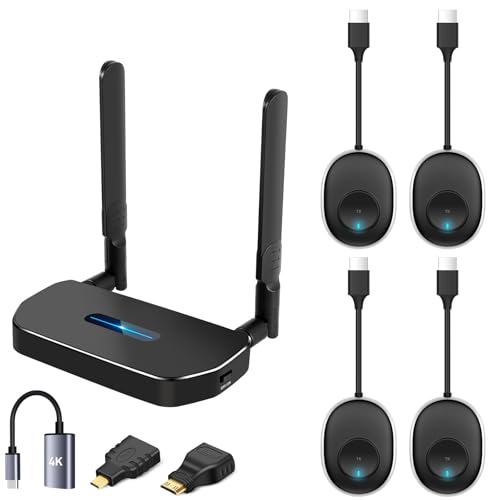
- Includes one receiver and four transmitters
- Switches among multiple computers with one key
- Plug-and-play mirroring or extended-display support
Best For: Meetings, classrooms, and shared office displays
Best Multi-User Monitoring Pick – Hollyland Pyro H
The Hollyland Pyro H is a strong choice among 4k wireless video receivers for crews that need reliable 4K monitoring across multiple displays. It supports 4K30 transmission, dual-band operation, up to 1,300 feet of range in suitable conditions, and connection to as many as four receivers.
Best For: Film crews, live-streaming teams, ENG/EFP work, and multi-user monitoring.
Pros:
- Transmits up to 4K30 over HDMI with 60ms latency.
- Supports 2.4GHz and 5GHz bands with Smart Channel Scan.
- Can send one feed to up to four receivers and supports Hollyview app monitoring.
- Includes HDMI loopout and UVC support for computer live streaming.
Cons:
- The 1,300-foot range is specified for suitable transmission conditions.
- The kit includes only one transmitter and one receiver.
- It uses H.264 encoding rather than an uncompressed video link.
Choose the Pyro H when collaborative monitoring and flexible streaming features matter as much as 4K picture quality. Its loopout, app support, and multi-receiver capability make it particularly practical for active production environments.
Best Plug-and-Play Home Setup – BovBox Wireless HDMI Extender
The BovBox Wireless HDMI kit is aimed at buyers who want a straightforward option among 4k wireless video receivers. Its pre-paired transmitter and receiver support 4K30 input, 1080p60 output, dual-band wireless operation, HDMI loopout, and multiple power options for portable use.
Best For: Home theaters, presentations, laptops, cameras, and portable HDMI setups.
Pros:
- Pre-paired plug-and-play design requires no app or software.
- Supports 4K30 and can provide a more stable 1080p experience.
- Offers up to 820 feet of transmission range in suitable conditions.
- Includes a 3.5mm audio interface and supports power banks, USB-C, or NP-F batteries.
Cons:
- NP-F batteries are not included.
- Adding receivers can shorten the transmission distance.
- The listed output is limited to 1080p60 rather than 4K output.
The BovBox makes sense when easy setup and flexible power are priorities. It is especially convenient for presentations and mobile installations, but buyers specifically needing a 4K display output should note its 1080p output specification.
Best HDMI and SDI Flexibility – Hollyland Mars 4K
The Hollyland Mars 4K is designed for production users comparing 4k wireless video receivers with professional SDI connectivity. It supports 4K30 over HDMI, HD formats over HDMI or SDI, broadcast-oriented decimal frame rates, and monitoring through connected displays or mobile devices.
Best For: Camera crews, broadcast-style production, switcher workflows, and mixed HDMI/SDI environments.
Pros:
- Supports 4K24/25/30 transmission through HDMI.
- Provides HDMI and 3G-SDI input/output options.
- Supports 23.98, 29.97, and 59.94 FPS SDI output.
- Offers a color LCD, joystick controls, app monitoring, and multiple power options.
Cons:
- Its stated range is 450 feet in interference-free laboratory conditions.
- Latency is listed at 66ms.
- QC/PD charging is not supported.
The Mars 4K is the more production-focused choice here when SDI compatibility and frame-rate flexibility are essential. Its shorter stated range than some alternatives is balanced by a professional interface set and useful on-device controls.
Best for Simple 1080p Display Links – Wireless HDMI Extender
This wireless HDMI extender is a practical option for buyers seeking 4k wireless video receivers but only needing a 1080p display output. It decodes 4K input, outputs 1080p at 60Hz, pairs automatically, and supports dual-band operation for home, office, classroom, and event use.
Best For: Presentations, classrooms, offices, home theaters, events, and large-room HDMI connections.
Pros:
- Accepts 4K-decoded input and outputs smooth 1080p60 video.
- Offers up to 360 feet in open spaces and a stated 165 feet indoors.
- Supports mirror and extend display modes without Wi-Fi, apps, or software.
- Can connect one receiver to up to eight transmitters and use three sets simultaneously.
Cons:
- It does not provide 4K output to the display.
- Walls can reduce transmission distance and speed.
- The near-zero-latency claim is product-stated rather than given as a measured figure.
This kit is best viewed as a convenient 1080p wireless display solution rather than a full 4K output system. Its automatic setup, display-mode support, and multi-transmitter capacity make it well suited to everyday presentations and distributed HDMI sources.
Professional Production Pick – Accsoon CineView SE 4K
For filmmakers who need 4k wireless video receivers with long range and flexible monitoring, the Accsoon CineView SE 4K combines HDMI and 3G-SDI support with 4K30 transmission. It can send video to multiple destinations and offers camera-control features for supported Sony and Canon models.
Best For: Professional film crews, directors, and multi-device monitoring setups.
Pros:
- Supports 4K input and output up to 30p through HDMI.
- Offers up to 1312 feet of range in clear, unobstructed conditions.
- Supports up to five monitoring destinations, including compatible mobile devices.
- Provides camera control for selected Sony and Canon cameras.
Cons:
- 4K latency is listed at approximately 0.1 seconds.
- Mobile monitoring requires compatible devices and the Accsoon SEE App.
- USB-C video output is not compatible with UVC computer capture.
The CineView SE 4K is a strong choice when production flexibility matters more than a simple point-to-point setup. Its SDI connectivity, multi-device support, and camera-control options make it especially suited to organized shoots and live production workflows.
Streaming-Friendly Value – VRRIIS WL096 PRO 4K
The VRRIIS WL096 PRO is one of the more versatile 4k wireless video receivers for live streaming and monitoring. Its pre-paired transmitter and receiver support 4K30 transmission, adjustable 5 GHz channels, loop-out monitoring, and UVC output for computer-based streaming.
Best For: Live streamers, outdoor video creators, and users who want direct computer connectivity.
Pros:
- Supports 4K30 transmission using H.265 encoding.
- UVC output enables streaming through OBS or other platforms without a capture card.
- Offers 20 selectable channels to help manage interference.
- Supports up to five receivers and includes transmitter loop-out.
Cons:
- Approximately 0.1-second latency is not recommended for highly responsive gaming.
- The system is not waterproof or water resistant.
- Battery power requires compatible NP-F batteries, which are not included.
With its LCD status displays, multiple power options, and UVC support, the WL096 PRO emphasizes practical operation. It is a compelling option for streaming workflows where computer output and flexible channel selection are more important than ultra-low latency.
Zero-Delay Performance Pick – Teradek Ace 750
The Teradek Ace 750 is designed for creators who prioritize responsive monitoring from 4k wireless video receivers. It delivers up to 4Kp30 10-bit HDR over HDMI, uses 6 GHz transmission, and claims less than 0.01 seconds of latency across a range of up to 750 feet.
Best For: Camera operators, mirrorless shooters, and A/V workflows requiring near-zero-delay monitoring.
Pros:
- Supports 4Kp30 10-bit HDR image quality through HDMI.
- Uses 6 GHz transmission with 12 frequency options and automatic channel selection.
- Provides less than 0.01-second latency according to the supplied specifications.
- Ships paired out of the box and supports Bluetooth app control.
Cons:
- Its 750-foot range is shorter than some competing systems listed here.
- The system is HDMI-only rather than offering SDI connectivity.
- A second AC adapter for additional studio or A/V setups is sold separately.
The Ace 750 stands out for real-time operation rather than maximum range or broad connector support. Its 6 GHz platform, HDR capability, and very low stated latency make it a focused choice for camera-to-monitor links where delay can disrupt production.
Best with Extra Features – Accsoon CineView Master 4K
For filmmakers and live-production teams comparing 4k wireless video receivers, the Accsoon CineView Master 4K stands out for its SDI and HDMI connectivity, tri-band transmission, and professional monitoring features. It supports up to 4K at 60 fps through HDMI, with stated ranges and latency depending on resolution and shooting conditions.
Best For: Filmmaking, event production, sports coverage, live streaming, and multi-person monitoring.
Pros:
- Supports HDMI video up to 4K60 and 1080p through 3G-SDI or HDMI.
- Tri-band 2.4GHz, 5GHz, and 6GHz operation is designed for stable wireless transmission.
- Can send video to up to four receivers or compatible mobile devices.
- Accsoon SEE adds tools such as recording, live streaming, waveforms, focus peaking, and false color.
Cons:
- The advertised 8,202-foot range requires an unobstructed, interference-free environment.
- Stated latency is higher at 4K than at 1080p, and camera latency is not included.
- Some monitoring and Frame.io features depend on compatible devices or the Accsoon app.
This is the most production-oriented option in the group, especially if SDI support, detailed monitoring tools, and multi-device collaboration matter more than simple home setup.
Long-Range Home Theater Pick – Vrriis WL095P 4K Wireless HDMI Kit
The Vrriis WL095P is a practical choice among 4k wireless video receivers for sending HDMI video from a camera, laptop, PC, or other source to a distant display. Its pre-paired transmitter and receiver are designed for plug-and-play use, with 4K at 30Hz support and dual HDMI outputs on the receiver.
Best For: Home theaters, presentations, classroom or office displays, and streaming from a nearby HDMI source.
Pros:
- Pre-paired setup requires no app or driver installation.
- Supports UHD 4K at 30Hz with synchronized audio.
- Claims up to 1,150 feet in an open, interference-free field.
- Dual HDMI outputs can support multiple monitors, with additional receivers available for expansion.
Cons:
- Walls, metal, brick, and glass can significantly reduce the stated range.
- 4K support is limited to 30Hz according to the supplied specifications.
- Expanded multi-monitor setups may shorten wireless transmission distance.
Choose this kit when straightforward installation, long open-area reach, and flexible HDMI display output are priorities. For demanding production monitoring, it offers fewer specialized tools than the Accsoon system.
Multi-Source Meeting Pick – 4K Wireless HDMI Switch Kit
This multi-transmitter kit is useful when comparing 4k wireless video receivers for meetings, classrooms, or a shared display. It includes one receiver and four transmitters, allowing users to switch between computer sources while supporting resolutions up to 4K at 30Hz.
Best For: Offices, presentations, classrooms, and switching several computers to one TV or projector.
Pros:
- Includes four transmitters and supports pairing with up to eight transmitters in theory.
- Factory-paired plug-and-play design requires no app, Bluetooth, or Wi-Fi.
- Supports screen mirroring and extending a computer display.
- Works with devices such as PCs, laptops, cameras, cable boxes, and game consoles through HDMI.
Cons:
- It is designed to send multiple sources to one receiver/display, not to distribute one source across multiple TVs.
- The stated 165-foot range applies without barriers, and walls can affect performance.
- Transmitters and receiver require suitable USB power; chargers are not included.
This kit makes the most sense for source switching rather than cinematic long-distance distribution. Its included transmitters can simplify shared-screen setups, provided the display has adequate USB power and the range is suitable.
How We Picked the Best 4K Wireless Video Receivers
We evaluated these 4K Wireless Video Receivers according to the features that most affect everyday use: supported resolution and frame rates, end-to-end latency, stated transmission range, HDMI or SDI compatibility, wireless frequency bands, receiver capacity, power options, and setup complexity. We also considered whether each system is better suited to casual screen extension, live production, camera monitoring, or professional video distribution.
Advertised range is measured under ideal conditions. Walls, metal structures, crowded wireless environments, antenna placement, and video bitrate can reduce practical distance, so the strongest specifications should be treated as a starting point rather than a guarantee.
Quick Comparison
| Priority | Look For | Best Fit |
|---|---|---|
| Professional production | SDI and HDMI, stable wireless operation, low latency | Cinema, broadcast, and event crews |
| Highest image quality | 4K30 or 4K60 support, HDR, high-bit-depth transmission | Premium monitoring and large displays |
| Multiple viewers | Multi-receiver support or app monitoring | Directors, assistants, and production teams |
| Simple home or office use | Plug-and-play HDMI, automatic pairing, loopout | Presentations and cable-free displays |
| Long-distance links | Strong range claims, external antennas, clear line of sight | Studios, venues, and remote monitors |
Key Buying Factors for 4K Wireless Video Receivers
Resolution, Frame Rate, and HDR
Confirm the complete signal path, not just the product name. Many systems accept 4K input but transmit at 4K30 or downconvert to 1080p. If you need smooth sports, camera movement, or gaming, check for 1080p60 support. HDR and 10-bit support matter for high-end monitoring but require compatible source and display equipment.
Latency and Reliability
Low latency is essential for live camera operation, events, and interactive content. A claimed delay of 25 to 60 milliseconds can be suitable for many monitoring tasks, while higher-delay systems are better for presentations or casual viewing. Dual-band or tri-band designs may handle interference better, but placement and line of sight remain important.
Inputs, Outputs, and Compatibility
Choose HDMI-only equipment for consumer cameras, laptops, and media players. Choose a system with SDI when working with cinema or broadcast cameras. HDMI loopout is useful when the transmitter must feed a local monitor, while USB or UVC output can simplify webcam and streaming workflows. Verify connector versions, supported frame rates, and HDCP requirements before buying.
Range, Power, and Installation
Long-range figures generally assume an unobstructed path. For dependable operation, prioritize systems with clear status indicators, secure mounting, flexible power options, and accessible antennas. Battery-powered transmitters are convenient on camera rigs; AC-powered kits are usually better for permanent installations.
Who Should Buy Which 4K Wireless Video Receivers?
Choose a professional Hollyland, Accsoon, or Teradek system if you need dependable camera monitoring, SDI compatibility, multiple receivers, very low latency, or advanced production features. A premium tri-band or 6GHz model is appropriate when interference control, 4K60, HDR, or multi-device monitoring is central to the workflow.
For presentations, home entertainment, and straightforward laptop-to-display connections, a plug-and-play HDMI kit is usually the better value. Buyers who need long-distance transmission should prioritize a clear line of sight and stable performance over the largest advertised range. If streaming is the goal, select a model with loopout or UVC support so you can monitor locally and connect directly to a computer or capture workflow.