The best capture cards under $200 make it easier to stream console gameplay, record footage, and add HDMI cameras to a computer without overspending. The right model depends on more than headline resolution: passthrough refresh rate, input latency, audio handling, and software compatibility matter just as much.
This roundup compares 10 affordable capture cards for PS5, Xbox Series X/S, Switch, PC gaming, and camera workflows, with options ranging from simple plug-and-play USB devices to more feature-rich streaming hardware.
Best 10 Capture Cards Under 200 Picks for 2026
Best Budget USB-C Capture

- 1080p60 output with up to 4K30 input
- Plug-and-play USB-C/USB connectivity
- Compatible with OBS, Zoom, and major platforms
Best For: Budget streamers needing portable HDMI capture
Best Premium Gaming Capture

- 4K60 capture with HDR10 support
- 1440p120 and 1080p240 passthrough
- Analog audio input for chat or commentary
Best For: Console gamers seeking high-frame-rate features
Best Versatile Streaming Value
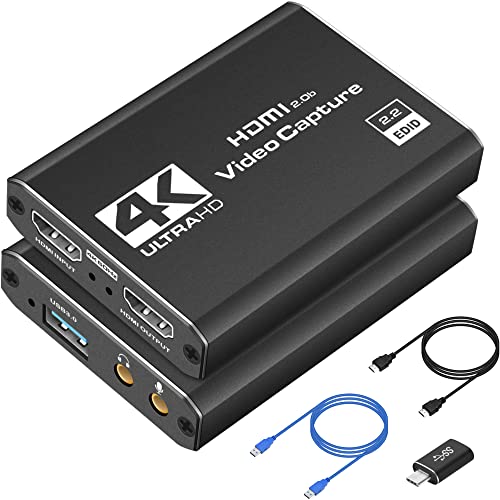
- 1080p60 recording with 4K preview
- HDMI loop-out for gameplay passthrough
- Works with consoles, cameras, OBS, and Streamlabs
Best For: Beginners wanting flexible streaming connectivity
Best Zero-Lag Passthrough

- 1080p60 capture and passthrough
- Built-in H.264 hardware encoder
- UVC plug-and-play operation
Best For: Console streamers prioritizing lag-free gameplay
Best Budget USB Capture
Audio Express AXHDCAP 4K HDMI Capture Card

- 4K30 HDMI input with 1080p30 USB capture
- Plug-and-play support for Windows, macOS, and Linux
- USB 2.0 design suits basic streaming and recording
Best For: Entry-level streaming, teaching, calls, and everyday 1080p capture
Best for Console Streaming
NearStream CCD10 HDMI Capture Card

- 1080p60 capture over USB-C 3.0
- 4K60, 1440p120, and 1080p240 passthrough
- Dual 3.5mm ports for mic and headset audio
Best For: Console streaming with smooth high-refresh passthrough
Best High-Refresh Option
BlueAVS Cyber4K HDMI Capture Card

- Up to 4K60, 1440p144, and 1080p240 capture and passthrough
- Supports HDR, VRR, ALLM, and ultrawide 21:9 setups
- USB 5Gbps plug-and-play connection with audio mixing
Best For: High-refresh console, PC, and ultrawide gaming setups
Best Value 4K Input

- 4K/30Hz HDMI input with 2K/30Hz or 1080p/60Hz recording
- USB 3.0 and USB-C plug-and-play connectivity
- Works with consoles, cameras, OBS, Zoom, Windows, and macOS
Best For: Portable streaming and recording setups needing broad compatibility
Best for Pass-Through Gaming

- HDMI loop-out supports low-delay gameplay
- Accepts 4K30/60Hz and 1080p120/144Hz input
- Includes 3.5mm TRS microphone support
Best For: Console gaming with live commentary and a separate monitor
Best Features for Streamers

- 1080p/60fps capture with 4K/30fps HDMI loop-out
- LINE IN and headset ports for gaming audio
- Nine RGB modes plus one-year warranty
Best For: Gaming streamers building an audio-equipped, customizable desk setup
Best Budget USB-C Capture – 1080p60 HDMI Capture Card
If you need capture cards under 200 for basic streaming, recording, meetings, or gameplay, this compact USB 3.0 model offers up to 1080p at 60 fps output. It accepts HDMI input up to 4K at 30 Hz and includes USB-C connectivity, though it requires capture software rather than sending video directly to a monitor.
Best For: Budget-conscious streamers and users who need a portable HDMI-to-computer capture solution.
Pros:
- Captures 1080p video at up to 60 fps.
- Plug-and-play design requires no additional drivers or external power.
- Works with Windows, macOS, Linux, Android, OBS, VLC, Zoom, and major streaming platforms.
Cons:
- Requires capture software and is not intended for direct screen casting.
- USB 3.0 is recommended for the listed bandwidth and resolution.
- Audio setup in OBS may require restarting the software.
This is a practical low-cost option for straightforward capture and streaming. Its included adapter and portable design add flexibility, but users should pay attention to USB mode and software setup.
Best Premium Gaming Capture – Elgato 4K S
Among capture cards under 200, the Elgato 4K S stands out for gaming-focused features such as 4K60 capture, HDR10 support, and high-frame-rate passthrough. It is designed for PS5, Xbox Series X/S, Switch 2, and other compatible devices, with USB-C connectivity and an analog audio input.
Best For: Console gamers and creators who want high-quality capture with high-frame-rate passthrough.
Pros:
- Captures video in 4K at 60 fps.
- Supports 1440p120 and 1080p240 passthrough.
- Includes HDR10 support and a 3.5 mm analog audio input.
Cons:
- Windows use requires Windows 11 according to the listed specifications.
- Requires compatible hardware, including a USB 3.0 Type-C port.
- The supplied video capture resolution detail lists 1080p, so buyers should verify their intended recording workflow.
The 4K S is the feature-rich choice in this group for modern console setups. Its HDR and high-frame-rate support make it more suitable for demanding gaming use than basic 1080p capture devices.
Best Versatile Streaming Value – 4K HDMI Capture Device
For shoppers comparing capture cards under 200, this USB 3.0 device combines 1080p60 capture with 4K HDMI real-time preview and HDMI loop-out. It supports consoles, cameras, PCs, and popular streaming software, making it a flexible choice for beginners and traveling creators.
Best For: New streamers who want broad device compatibility, simple setup, and HDMI passthrough.
Pros:
- Records 1080p video at 60 fps.
- Offers 4K HDMI preview and HDMI loop-out.
- Works with OBS, Streamlabs, XSplit, Windows, macOS, PS5, Xbox, Switch, and cameras.
Cons:
- Requires a USB 3.0 port.
- The product is primarily a 1080p60 capture device despite 4K input and preview claims.
- Listed warranty coverage is one year.
Its included cables and adapters improve setup flexibility, while the loop-out connection can help maintain a practical gaming workflow. It is a strong all-purpose option when 1080p60 recording is sufficient.
Best Zero-Lag Passthrough – AVerMedia Live Gamer Mini
The AVerMedia Live Gamer Mini is a compact choice among capture cards under 200, recording Full HD at 1080p60 while providing zero-lag 1080p60 HDMI passthrough. Its UVC plug-and-play design and built-in H.264 encoder make it well suited to console streaming with minimal computer setup.
Best For: Console streamers who prioritize zero-lag passthrough and low CPU impact.
Pros:
- Records clean 1080p video at 60 fps.
- Provides 1080p60 HDMI passthrough with zero latency.
- Built-in H.264 hardware encoding reduces load on the computer CPU.
Cons:
- Capture resolution is limited to 1080p.
- Uses a USB Micro-B connection rather than USB-C.
- Compatibility is listed for Windows 10/11 and macOS 12, so newer systems should be checked.
This is a focused, dependable option for Full HD console streaming rather than high-resolution capture. Its compact body, hardware encoder, and three-year manufacturer warranty add appeal for regular streamers.
Best Budget USB Capture – Audio Express AXHDCAP 4K HDMI Capture Card
If you need capture cards under 200 for basic streaming, recording, or video calls, the Audio Express AXHDCAP offers a simple HDMI-to-USB setup. It accepts up to 4K input at 30Hz but outputs captured video at up to 1080p30 over USB 2.0.
Best For: Entry-level streamers, educators, video conferencing, and users who need plug-and-play 1080p capture.
Pros:
- Supports HDMI input up to 3840×2160 at 30Hz.
- Captures video at up to 1920×1080 at 30Hz with stereo sound.
- Works with Windows, macOS, and Linux without drivers or external power.
- Compatible with OBS, Twitch, YouTube, Zoom, VLC, and PotPlayer.
Cons:
- USB 2.0 limits capture speed and resolution.
- Maximum capture output is 1080p30 rather than 1080p60.
- It is not designed to add HDMI output to a laptop or desktop without HDMI-out.
The AXHDCAP is a practical low-cost option when straightforward 1080p recording matters more than high-frame-rate gameplay. Its broad software and operating-system compatibility makes setup easy, but competitive gamers should consider a faster USB 3.0 model.
Best for Console Streaming – NearStream CCD10 HDMI Capture Card
Among capture cards under 200, the NearStream CCD10 stands out for console players who want smooth gameplay on a monitor while recording or streaming. It captures up to 1080p60 through USB-C 3.0 and supports high-refresh passthrough for compatible displays.
Best For: PS5, PS4, Xbox, and Switch users who want 1080p60 capture, high-refresh passthrough, and flexible headset or microphone connections.
Pros:
- Captures up to 1080p at 60fps through USB-C 3.0.
- Supports 4K60, 1440p120, and 1080p240 passthrough.
- Includes separate 3.5mm microphone and headset audio connections.
- Works with Windows, macOS, and Linux and includes HDMI and USB cables.
Cons:
- Capture resolution is limited to 1080p60.
- USB 3.0 is required for the stated capture performance.
- Higher-resolution formats have system requirements that may exceed basic computers.
The CCD10 is a well-rounded choice for console streaming because it separates smooth display passthrough from practical 1080p60 recording. Its audio ports are especially useful for streamers using a headset or external microphone.
Best High-Refresh Option – BlueAVS Cyber4K HDMI Capture Card
For shoppers comparing capture cards under 200, the BlueAVS Cyber4K is aimed at high-refresh gaming and advanced passthrough. It supports capture and passthrough modes up to 4K60, 1440p144, and 1080p240, provided it is connected to a USB 5Gbps or faster port.
Best For: PS5 and PC gamers, esports recording, ultrawide setups, and creators who need high-refresh passthrough with flexible audio connections.
Pros:
- Supports capture and passthrough up to 4K60, 1440p144, and 1080p240.
- Handles ultrawide 21:9 input and supports HDR, VRR, and ALLM passthrough features.
- Offers 3.5mm line-in and headset audio connections.
- UVC/UAC plug-and-play compatibility works with Windows, macOS, and Linux.
Cons:
- Full performance requires a USB 5Gbps or faster port.
- USB 2.0 ports support only up to 1080p according to the supplied notes.
- High-resolution recording modes may require capable streaming hardware and software.
The Cyber4K is the strongest fit here for high-refresh gaming and modern display features. It offers more headroom than basic capture devices, but buyers should confirm their computer has the required USB bandwidth before choosing it.
Best Value 4K Input – Compact USB-C Capture Card
If you are comparing capture cards under 200 for streaming, recording, or online meetings, this VIXLW model offers 4K HDMI input with flexible USB 3.0 and USB-C connectivity. It can record at 2K/30Hz or 1080p/60Hz and works with common consoles, cameras, computers, and streaming software.
Best For: Gamers and creators who want a compact, plug-and-play capture card with 4K input and broad device compatibility.
Pros:
- Supports up to 4K/30Hz HDMI input and 1080p/60Hz recording
- USB 3.0 and USB-C connection options with no external power required
- Compatible with Windows, macOS, Linux, Android, OBS, Zoom, Twitch Studio, and VLC
- Compact aluminum-alloy design is convenient for portable setups
Cons:
- Maximum listed recording output is 2K/30Hz or 1080p/60Hz, not 4K recording
- Tablet use requires OTG support to be enabled
This is a versatile choice when easy setup, portability, and wide compatibility matter more than native 4K recording. Verify that your computer has adequate processing power for the desired capture resolution.
Best for Pass-Through Gaming – 1080p60 Capture Card
Among capture cards under 200, this VIXLW model stands out for gaming setups that need HDMI loop-out and commentary support. It captures up to 1080p and accepts higher-resolution input, while USB 3.0 connectivity supports streaming through OBS, Twitch, YouTube, Facebook, and other compatible software.
Best For: Console players who want low-delay HDMI pass-through and a dedicated microphone input for game commentary.
Pros:
- Supports 4K30/60Hz and 1080p120/144Hz video input
- HDMI loop-out is designed for playing without capture delay
- Plug-and-play operation requires no driver or external power supply
- 3.5mm microphone input supports external commentary with a TRS headset
Cons:
- Capture resolution is listed up to 1080p, with output up to 2K/30Hz
- Does not support 4K120Hz or 4K144Hz input
- Microphone input accepts 3.5mm TRS standard headsets only
This model is most practical for players who prioritize a responsive local display and simple commentary setup. Its capture limits are worth checking against your preferred resolution and refresh rate.
Best Features for Streamers – Fifine AmpliGame V3
For shoppers comparing capture cards under 200, the Fifine AmpliGame V3 combines 1080p/60fps capture with 4K/30fps HDMI loop-out and streaming-focused audio connections. Its plug-and-play design, RGB lighting, and compatibility with OBS, YouTube, Discord, and Twitch make it suited to gaming and creator desks.
Best For: Streamers who want smooth 1080p capture, zero-latency monitor pass-through, and built-in audio and RGB features.
Pros:
- Captures 1080p at 60fps through USB 3.0
- Provides 4K/30fps HDMI loop-out for delay-free gameplay monitoring
- Includes LINE IN and headset ports for an expanded gaming audio setup
- Offers nine RGB lighting modes and a one-year warranty
Cons:
- Requires HDMI input/output and a USB 3.0 port
- Its listed capture resolution is 1080p rather than native 4K
- The manufacturer recommends using the original USB cable for best performance
The V3 is a strong fit for a dedicated gaming or streaming desk where audio controls and visual customization are useful. Choose it over a simpler card if its RGB and headset features match your setup.
How We Picked the Best Capture Cards Under 200
We focused on capture cards priced below $200 that cover the most common uses: console streaming, gameplay recording, webcam or DSLR input, and live production. We considered advertised capture and passthrough resolutions, frame rates, connection type, operating-system support, HDMI compatibility, audio features, and setup requirements.
Because specifications can vary by source device and software, treat 4K labels carefully. Some models capture at 1080p while accepting or passing through a 4K signal. For streaming, stable 1080p at 60 frames per second is often more useful than an unsupported maximum resolution.
Quick Comparison
- Best for straightforward console streaming: AVerMedia Live Gamer Mini, with plug-and-play operation and HDMI passthrough.
- Best for newer consoles: Elgato 4K S, designed for current PlayStation, Xbox, and Switch workflows.
- Best for flexible low-cost setups: USB 3.0 HDMI capture cards that support 1080p60 and USB-C connectivity.
- Best for audio-focused streaming: Models with dedicated audio support, such as the Audio Express and Fifine options.
- Best for camera use: NearStream CCD10 and other HDMI-to-USB models that accept DSLR or camcorder output.
Key Buying Factors for Capture Cards Under 200
Capture Resolution and Frame Rate
For fluid gameplay, prioritize 1080p at 60fps. If you want to record 4K footage, verify whether the card truly captures 4K or only passes it through to a display. A 4K60 passthrough feature can preserve a high-resolution gaming experience while the computer records a smaller stream.
Passthrough and Latency
HDMI passthrough lets you play on a monitor or TV while the computer handles capture. Look for a passthrough refresh rate that matches your console and display. Low-latency operation is especially important for competitive games, where playing from the preview window can feel delayed.
USB Connection and Compatibility
USB 3.0 is generally preferable for higher-bandwidth capture, while USB 2.0 models may be adequate for basic 1080p streaming. Check whether the included cable uses USB-C, USB-A, or an adapter, and confirm support for your version of Windows or macOS before buying.
Audio and Software Support
Confirm that the card carries HDMI audio correctly and works with your preferred software, such as OBS, Streamlabs, Zoom, or Teams. Dedicated audio inputs can help with microphones, mixers, or game-audio routing, but they may add setup complexity.
Who Should Buy Which Capture Cards Under 200?
Choose a basic USB 3.0 model if you want an inexpensive way to stream a console or camera at 1080p60. Select the AVerMedia or Elgato option if reliable brand support, passthrough, and a simpler setup matter more than the lowest price. Gamers using PS5, Xbox Series X/S, or Switch 2 should verify current HDMI and resolution support before purchase. Content creators combining game audio, microphones, and live production should favor a model with clearer audio-routing features, while casual users can save money with a compact plug-and-play card.